

Summary: An employee performance review template is a structured form managers use to evaluate performance, recognize strengths, identify development areas, and set goals. Most organizations already have a template in place, but reviews often fall short because of how it’s used, not the form itself. The most effective reviews tie ratings to specific examples, focus on impact, and are led by managers who give clear feedback and follow up throughout the year.
Most organizations already have an employee performance review template in place. It might be built into an HR system, developed internally by HR, or passed down from one review cycle to the next. Yet even with a solid form, many managers still struggle to lead reviews that feel fair, specific, and useful, and many employees walk away unsure where they stand.
The problem usually isn’t the template. It’s how the template is used.
A form can prompt the right questions, but it can’t make a manager prepare thoughtfully, give specific feedback, or turn a rating into a real development conversation. That takes leadership.
This guide covers what an effective performance review should include, how to evaluate the template you already have, and how to help managers get more out of every review. If you’re building a process from scratch, you’ll also find a complete reference template below.
Why Having a Performance Review Template Isn’t the Same as Having Effective Reviews
When a review process has been in place for a while, it can quietly turn into a compliance exercise. Managers fill in the boxes, submit the form, and move on. Over time, a few common patterns show up.
Ratings start to cluster around “meets expectations,” regardless of actual performance. Comments become vague and interchangeable from one employee to the next. Feedback reflects the last few weeks instead of the full review period. Goals are set during the review and not revisited until the next one.
None of these are template problems. They are signs that managers need more clarity, confidence, and skill to lead the conversation well. Before replacing your system or redesigning your form, it’s worth looking at how reviews are actually being conducted.
What Should an Employee Performance Review Include?
A complete employee performance review covers past performance, current strengths, development opportunities, and future goals. Most established templates already include some version of these elements. Use the table below as a quick check against your current form, and more importantly, against how managers are completing it.
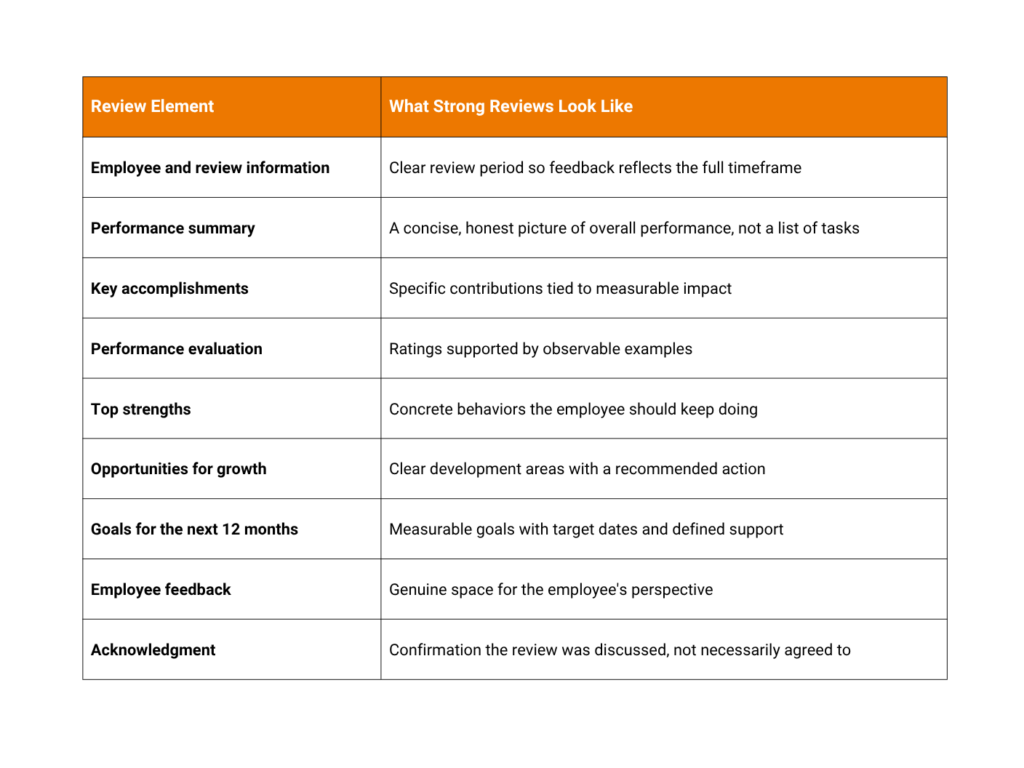
If your template covers these areas, the opportunity is in the quality of what goes into each section. If it’s missing some, those gaps are worth addressing in your next process update.
How to Get More Out of Your Existing Employee Performance Review Template
Whatever form your organization uses, these practices help managers turn it into a more meaningful conversation.
Focus accomplishments on impact, not activity.
“Managed the client onboarding project” describes a task. “Led client onboarding for 12 new accounts, reducing time-to-launch by three weeks” describes a contribution. Encourage managers to connect every accomplishment to what it made possible for the team, clients, or organization.
Anchor every rating in evidence.
A rating without an example is an opinion. Managers should be able to point to specific behaviors or results that support each score. This makes ratings more defensible and easier for employees to understand and act on.
Calibrate across managers.
Even with a shared rating scale, one manager’s “exceeds expectations” may be another’s “meets.” Calibration conversations, where leaders review ratings together before they’re finalized, help create consistency and reduce bias across teams.
Make development areas actionable.
Naming a weakness isn’t enough. Each development area should include why it matters and what the employee can do about it, whether that’s a stretch assignment, coaching, or training.
Connect goals to what comes next.
Strong goals link the employee’s growth to organizational priorities. They also give managers a clear reason to check in throughout the year instead of waiting for the next formal review.
Ask for employee input before the meeting.
When employees reflect on their own performance in advance, the conversation becomes a genuine dialogue rather than a one-way evaluation.
Signs Your Performance Review Process Needs a Refresh
Even well-designed processes can drift over time. Your approach may need attention if managers describe reviews as a paperwork burden rather than a valuable conversation, or if most employees receive the same rating regardless of performance. Other warning signs include employees being surprised by feedback during their review, high performers leaving without having had meaningful development conversations, and goals rarely being referenced after the review is complete.
In many cases, the fix isn’t a new form. It’s equipping managers with the skills to set expectations, give clear feedback, and coach consistently throughout the year.
Reference Employee Performance Review Template
Use this employee performance review template to benchmark your current form or as a starting point if you’re building a process from the ground up.
Employee Information
Employee Name, Job Title, Department, Manager, Review Period, Review Date
1. Overall Performance Summary
Briefly summarize the employee’s performance during the review period in the context of their role and responsibilities.
2. Key Accomplishments
Highlight 3–5 meaningful accomplishments and the impact each had on the team, clients, or organization. Consider goals or KPIs achieved, major projects completed, processes improved, and new responsibilities taken on.
- Accomplishment:
- Impact:
3. Performance Evaluation
Rating Scale:
- 5 — Exceptional: Consistently performs significantly above expectations
- 4 — Exceeds Expectations: Frequently performs above expectations
- 3 — Meets Expectations: Consistently performs the role well
- 2 — Needs Improvement: Performance is inconsistent or requires additional support
- 1 — Does Not Meet Expectations: Performance regularly falls below expectations
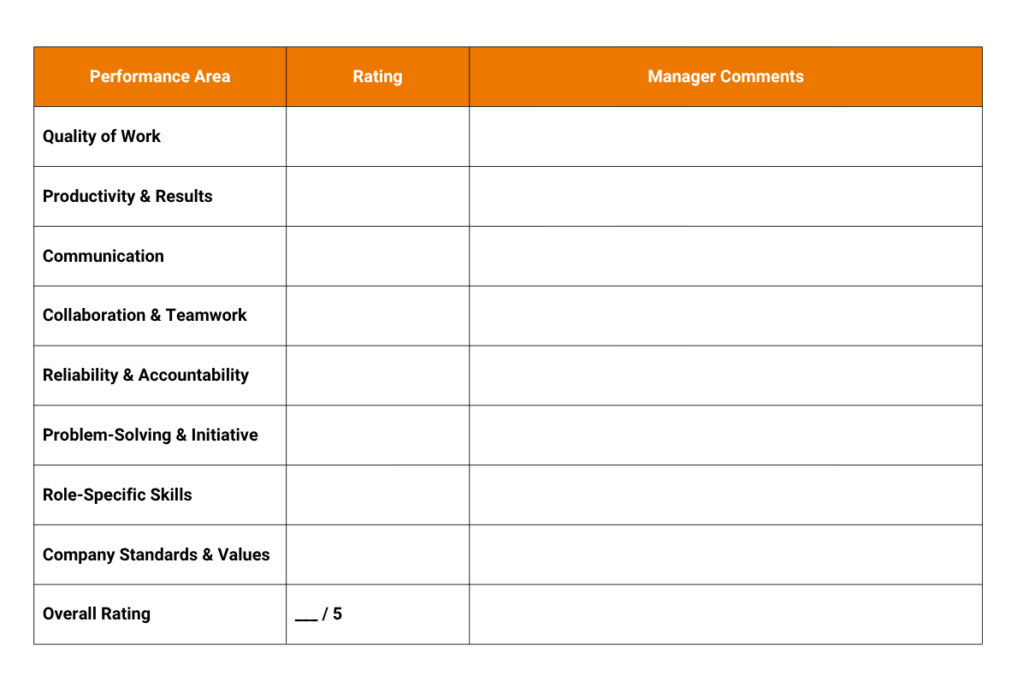
Most organizations use 6–9 performance areas, combining company-wide expectations (such as communication, accountability, and company values) with role-specific criteria (such as technical skills, KPI achievement, or people leadership).
4. Top Strengths
Identify 2–4 strengths the employee consistently demonstrates.
- Strength:
- Example:
5. Top Opportunities
Identify 2–4 areas where the employee can grow.
- Development Area:
- Why It Matters:
- Recommended Action:
6. Goals for the Next 12 Months
Set 3–5 goals tied to the employee’s role, development, and organizational priorities.
- Goal:
- Success Measure:
- Target Date:
- Support Needed:
7. Employee Feedback
- What accomplishments are you most proud of from this review period?
- What challenges or barriers affected your performance?
- What skills would you like to develop over the next 12 months?
- What support or resources would help you be more successful?
- Is there anything else you’d like to discuss?
8. Acknowledgment
Signatures confirm the review was discussed and do not necessarily indicate agreement.
Employee Name, Signature, Date / Manager Name, Signature, Date
Performance Review Feedback Examples
The quality of a review comes down to the feedback itself. Here’s what the difference looks like in practice.
Recognizing strong performance
- Instead of: “You’ve done a great job this year.”
- Try: “You consistently delivered high-quality work on time and communicated proactively when priorities changed. Your reliability helped the team stay on track.”
Addressing a performance concern
- Instead of: “You need to communicate better.”
- Try: “Project delays were sometimes communicated too late for the team to adjust. Going forward, flag potential roadblocks earlier so there’s time to find solutions.”
Identifying a growth opportunity
- Instead of: “You need to be more strategic.
- Try: “You consistently execute your responsibilities well. As a next step, focus on anticipating longer-term needs and connecting your recommendations to broader organizational priorities.”
The Template Is the Tool. Leadership Is the Difference.
An employee performance review template creates structure and consistency, but it can’t lead the conversation. The organizations that get real value from reviews are the ones whose managers know how to set clear expectations, give specific feedback, recognize strong performance, and navigate difficult conversations throughout the year, not just at review time.
Leadership Worth Following helps organizations strengthen these capabilities through leadership assessments, leadership development, executive coaching, and succession planning. We combine great consulting with great science to help organizations identify and develop leadership worth following.
If your review process is in place but isn’t producing the conversations or results you expect, request a free consultation with Leadership Worth Following to see where your leaders can grow.